
Dance tunes for the fiddle written by Jónas Helgason around 1864
This project has been successfully funded and is now executing.
raised of €2,700 goal
days to go
Backers

{{ reward.description }}
{{ reward.description }}
To add milestones and tasks to your plan, please send them via e-mail to info@karolinafund.com. Tell us which tasks you have already finished (checked) and which ones are left.
Showing what the plan is for your project helps build trust with potential backers.
Dance tunes for the fiddle written by Jónas Helgason around 1864
Around the year of 1864, Jónas Helgason (1839-1903) wrote down dance tunes for the violin in a small notebook. Jónas was a popular dance musician in Reykjavík in the latter half of the 19th century and performed widely along with his brother, Helgi Helgason, and other musicians.
In the notebook, we find about 50 dance tunes, in addition to three songs. Icelandic dance music from the 19th century has not been the focus of research or publication, and therefore we have “new” music for the Icelandic traditional music repertoire. The notebook contains musical forms that have survived to this day, such as waltzes and reels, as well as forms that have been forgotten, such as the hamborger, bömerdans, engelsk dance, and more.
A large group of people from four countries has contributed to this ambitious publication, which includes:
1. Photographs of all pages of the notebook containing musical notation in full size and color.
2. Transcriptions of all the music in the notebook in modern notation.
3. Audio recordings of all the tunes in the notebook, interpreted based on the dance tradition and playing style of Icelandic folk fiddlers from the 20th century, performed by Vegar Vårdal, a Norwegian folk musician - and Folk Musician of the Year in Norway in 2020.
4. A biography chapter on Jónas Helgason.
5. A chapter about dance music in Reykjavík in the 19th century.
6. A chapter about the dances and dance styles in the notebook.
7. A chapter about the Icelandic folk fiddlers in the 20th century and their playing styles.
The book will be published in Icelandic. In addition to the book, we will offer courses and workshops. In August, we will introduce the music from the notebook to violin teachers in the Greater Reykjavík area and provide teaching materials that can be used at all educational levels in music schools.
Our Jónas' Dance Tunes project, will be a central theme of the 2025 Vaka Folk Festival, organised by the Vökufélagið - Folk Arts Association. The book launch event will be held at the festival, followed by a performance of some of the music and dances at the main concert of the festival.
There will also be open workshops based on the notebook material for instrument players, violinists and dancers at the festival.
Jónas’ Dance Tunes is an important community project. Everyone involved have contributed countless hours of work so that this little-known branch of Icelandic music and dance history can see the light of day, and we can once again play and enjoy dancing to it.
We therefore appeal to you to support us and help make this project possible.
The book will be produced and designed to serve both as a source of information and a practical sheet music edition. It will be printed on high-quality paper and spiral-bound, making it especially suitable for sight-reading. The spiral binding allows for the book to lie flat on a music stand and makes it easy to work with and accessible.
The edition will be published in an initial run of 150 copies. It will include all of the dance tunes from Jónas’ note book, transcribed into modern musical notation. Since full-color, full-size photographs of the original notebook will also be included, so readers will be able to compare our transcriptions with Jónas’ original handwriting and interpret the material for themselves.
To contextualise the notebook, we present short chapters about the cultural environment in which it was created, the dance tradition, and helpful information for interpreting the content of the notebook.
Alongside the sheet music edition, readers will be able to listen to specially made recordings of all the tunes. The recordings are interpreted both through the lens of the dance tradition and the local and personal playing styles of Icelandic folk fiddlers - who are also discussed in a dedicated chapter of the book.
Jónas Helgason was born in Reykjavík on February 28, 1839. He trained as a blacksmith and ran a smithy on Bankastræti in downtown Reykjavík. He was an avid singer and, together with his brother Helgi, founded the singing society Harpa, which is considered to have been one of the first polyphonic singing societies in Iceland. Jónas was active in Reykjavík’s musical scene, singing at funerals and playing the fiddle and dance gatherings, alongside his brother and other musicians.
Jónas went to Copenhagen to study music in 1875-76. Upon returning home, he began teaching singing in the Reykjavík Elementary School (Barnaskólinn) and at the Reykjavík Women’s School (Kvennaskólinn). In 1877 he became the organist at the Reykjavík Cathedral and taught organ playing as well. From 1881 onward, he worked exclusively in music. Jónas published numerous songbooks and music collections. He composed many songs, several of which remain well known today.
Despite a remarkable career and important contributions to Icelandic music culture, surprisingly little has been written about him. Here, we remember him for his fiddle playing and his participation in the popular dance culture of the mid 19th century Reykjavík. It is clear that Jónas’ influence on the musical heritage of Iceland has not been fully recognized and appreciated.
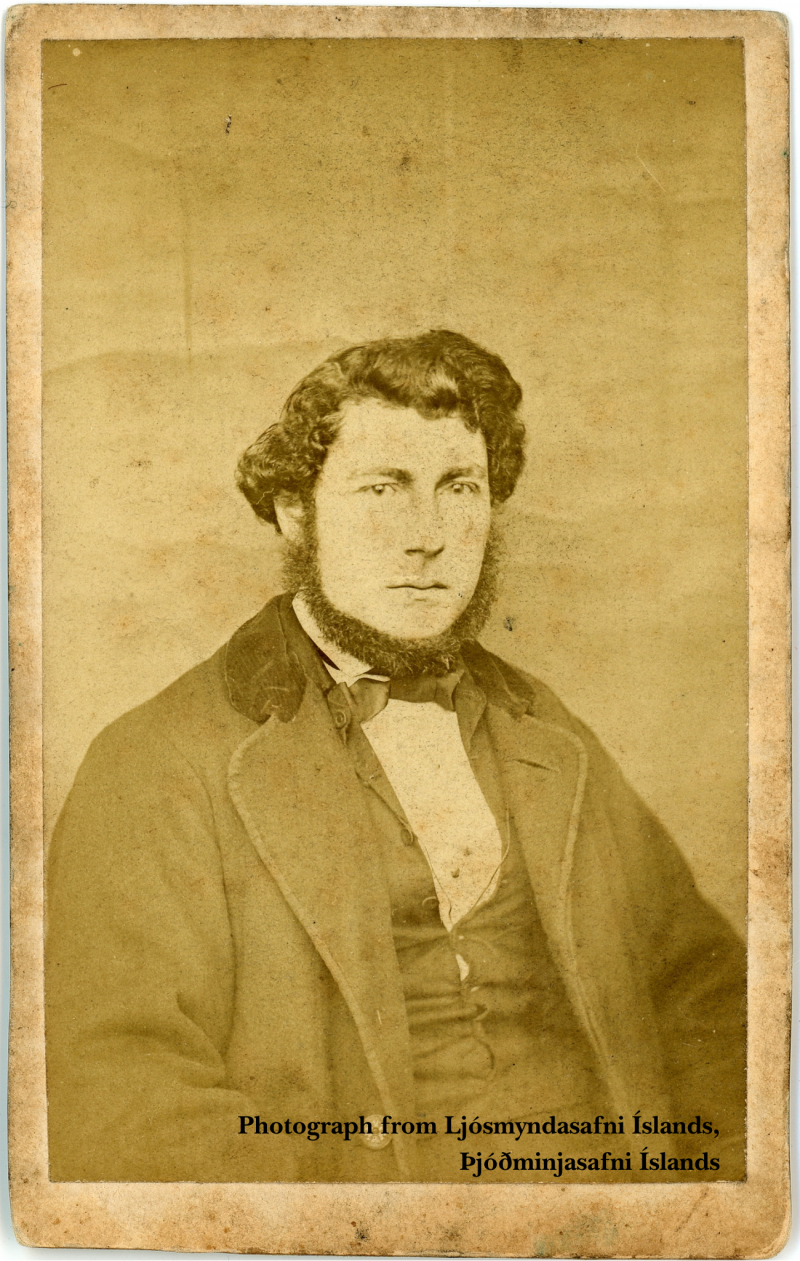
The dance culture in Reykjavík and the surrounding area was flourishing in Jónas’ time. Numerous sources mention dancing and musical accompaniment for dance as far back as the 18th century, though the descriptions are generally not very detailed. It is known, for example, that Magnús Stephensen learned to play the flute before departing for his studies in Copenhagen, which he completed in 1788, and that fiddles were played for dancing in Reykjavík as early as 1810.
However, no musical notation or written dance descriptions appear to have survived from this period - until now!
Jónas’ notebook is dated to around 1864, when he was 25 years old. It offers us an invaluable glimpse into the world of dance music in Reykjavík at that time. For instance, it is clear that waltzes were popular, judging by how prominently they feature in the manuscript. In total, it contains 22 waltzes, 11 galopades, 11 hamborgers, 2 reels, 1 bömerdans, 1 march, 1 toe tour, 1 tre tuer, 1 hopsa waltz, and 1 engelsk dans (English dance).
Some of these dances, such as the waltz and the reel, still survive in the living tradition in Iceland, while others, like the bömerdans and the engelsk dans - have not been danced for many decades.
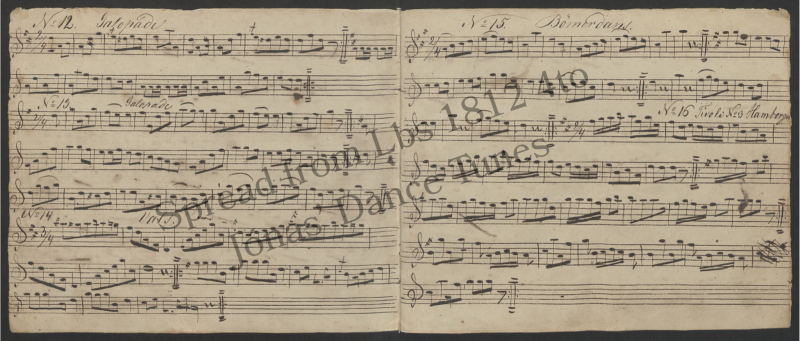
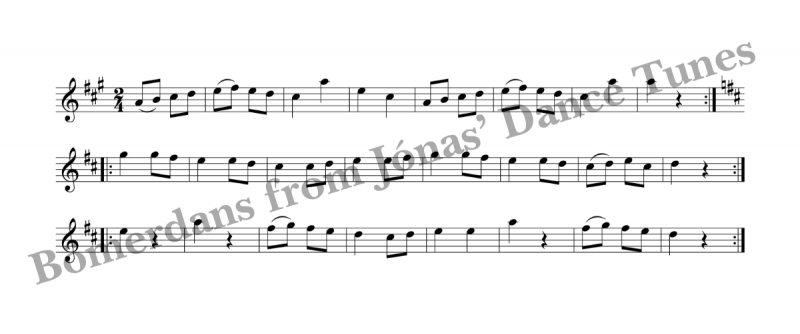
All of the tunes in the tunebook have been transcribed and arranged in a playable format by Inga Freyrsdóttir and Vegar Vårdal. Since the music is handwritten, Jónas’ penmanship is at times unclear, and some errors are present. These items have been corrected with the goal of making the music both accessible and listenable.
The music in the tunebook is almost exclusively dance music, with the exception of three songs found at the end. Because the primary purpose of dance music is to be played for dancing, it was an early priority for this publication to present the music in diverse and engaging ways. As well as the publication if the Jónas’ Dance Tunes book, all of the tunes in Jónas’ notebook will be professionally recorded by Vegar Vårdal.
As many of the tunes in the tunebook are part of a shared Nordic repertoire, it is possible to draw interpretive inspiration from musical traditions across the Nordic countries. At the same time, Icelandic tradition has been carefully considered: at the folklore archive of the Árni Magnússon Institute, recordings of four Icelandic folk fiddlers have been preserved. Vegar analyzed their playing styles and interprets the pieces in the tunebook in dialogue with those styles and through the lens of his own expertise.
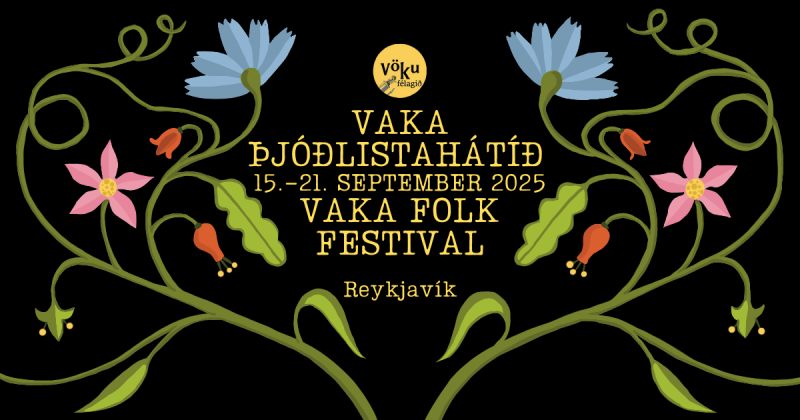
Jónas’ Dance Tunes is the theme of the Vaka Folk Arts Festival, which will take place from 15–21 September 2025.
In the lead-up to the festival, we will host a workshop for violin-teachers, where Vegar Vårdal will travel to Iceland to present traditional dance accompaniment and material from the notebook.
Selected tunes from the notebook will be arranged for all educational levels on the violin, and from 24. August until the festival in September, we aim for violin students in the Capital Area to learn to play tunes from Jónas’ Dance Tunes.
During the festival itself, additional workshops will be held for the students, and we hope to engage a group of Icelandic fiddlers to perform tunes from the notebook at the project launch event on September 19th.
At the main concert of the Vaka Folk Arts Festival, Vegar Vårdal will perform selections from the manuscript for the festival audience. Open workshops will also be available for musicians and dancers, offering the opportunity to engage with the traditional Icelandic music heritage through the tunes transcribed by Jónas.
On Sunday, September 21st, a symposium on the project will be held at Edda – The House of the Icelandic Language, in collaboration with the Árni Magnússon Institute for Icelandic Studies.
By supporting Jónas’ Dance Tunes, you help us preserve and share Iceland’s cultural heritage with future generations. This publication is the result of many years of work but is about much more than just publishing a book.
Workshops, events, educational material, and raising awareness are some of the projects we are working on alongside this book publication. We want to promote a dialogue between generations, and provide material for musicians to explore and use creatively. We hope this project will lead to people dancing to the music from the book and using it to enjoy themselves, connect, and build relationships. The book is the centerpiece of the project, and everything depends on it.
Countless hours of work have gone into preparing this publication, and now we need the final push to make it all come true.
As we say in Icelandic, margt smátt gerir eitt stórt, many small things make one big thing.
We sincerely thank you for your support and look forward to seeing you at the Vaka Folk Arts Festival in September.
For more updates and content related to the project, we encourage you to follow us on social media. There we share photos, videos, and other material that gives a better insight into the project:
Danslög Jónasar @ Facebook, Instagram & TikTok
You can also contact us by email if you have any questions: danslogjonasar@gmail.com
This project has been successfully funded and is now executing.
raised of €2,700 goal
days to go
Backers
{{ reward.description }}
{{ reward.description }}

Karolina Fund ehf © 2026 | Kt: 460712-1570 | VAT: 111464 | Bjargargata 1, 102 Reykjavík, Iceland